- Про Модель ООНКомитетыУчастие
- Про Модель ООН
Security Council (SC)
The United Nations Security Council bears primary responsibility for the maintenance of international peace and security. Its unique power sets it apart within the UN system: it is the only body whose decisions all Member States are obliged to carry out under the UN Charter. When the Council acts, its words carry the force of international law.
This authority rests with fifteen members. Five permanent members (China, France, the Russian Federation, the United Kingdom and the United States) hold the right of veto, and a single veto can block any substantive decision. They sit alongside ten non-permanent members, elected by the General Assembly for two-year terms to ensure fair geographic representation.
Faced with a threat to peace, the Council can act decisively: from calling for negotiations and imposing sanctions to deploying peacekeeping missions and, as a last resort, authorizing the use of force. Every one of these decisions is the product of difficult negotiation, and every vote can change the course of a crisis.
Only university students who have participated in at least 3 MUNs can become SC delegates!
Agenda: Crisis agenda
Distinguished Delegates,
Welcome to the Security Council, where the fate of the world is decided. Fifteen member states and four observers at one table. A single “no” can undo everything.
In this chamber, the loudest voice does not win. Victory belongs to those who know their country’s position inside out, think one step ahead of their opponents, and turn rivals into allies. Every resolution adopted here is born in debate, and every compromise is hard-won.
I do not promise you easy sessions. But I promise fierce debate, unexpected crises, and the moment when the outcome of a vote rests on your voice.
Sincerely,
President of the Security Council
Marina Kharitonova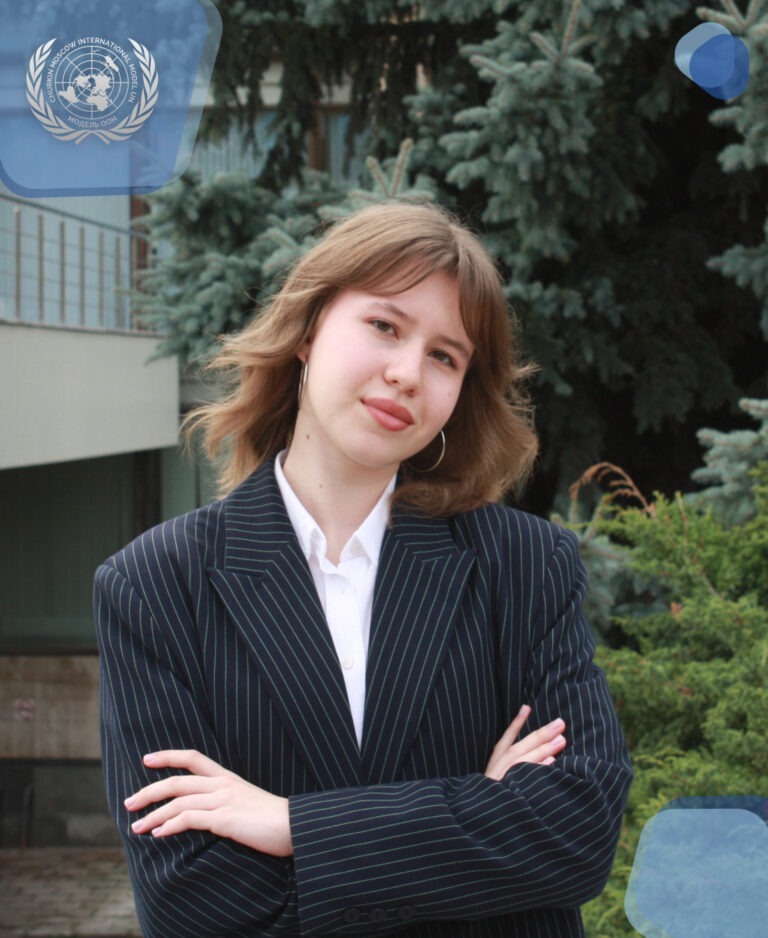
Dear Friends,
For me it is both great honour and high privilege to welcome you in the most outstanding committee of the annual UN Model, held at the Moscow State Institute of International Relations!
Today our World faces significant number of challenges and crises, that threaten all humanity without exception. The core mission of the United Nations is to solve these issues and build better world for current generation and future ones. Especially prominent role in this process belongs to the Security Council. Being responsible for billions of lives, you will encounter one of the most acute crises, requiring urgent solution. Our path to peace, safety and stability will be complicated and demand all your negotiation skills. Remember, that diplomacy is the art of word, urging, respect, compromise, dignity and the key to the right solution. I warmly wish you fruitful and constructive discussions, successful and sustainable decisions during our committee sessions. And also, I express my firm conviction, that human courage and devotion to the principles of the UN will help us to bridge all differences. Today we can architect the better world for tomorrow.
Now the floor is yours.
Respectfully,
Security Council Vice-President
Maxim Kurenkov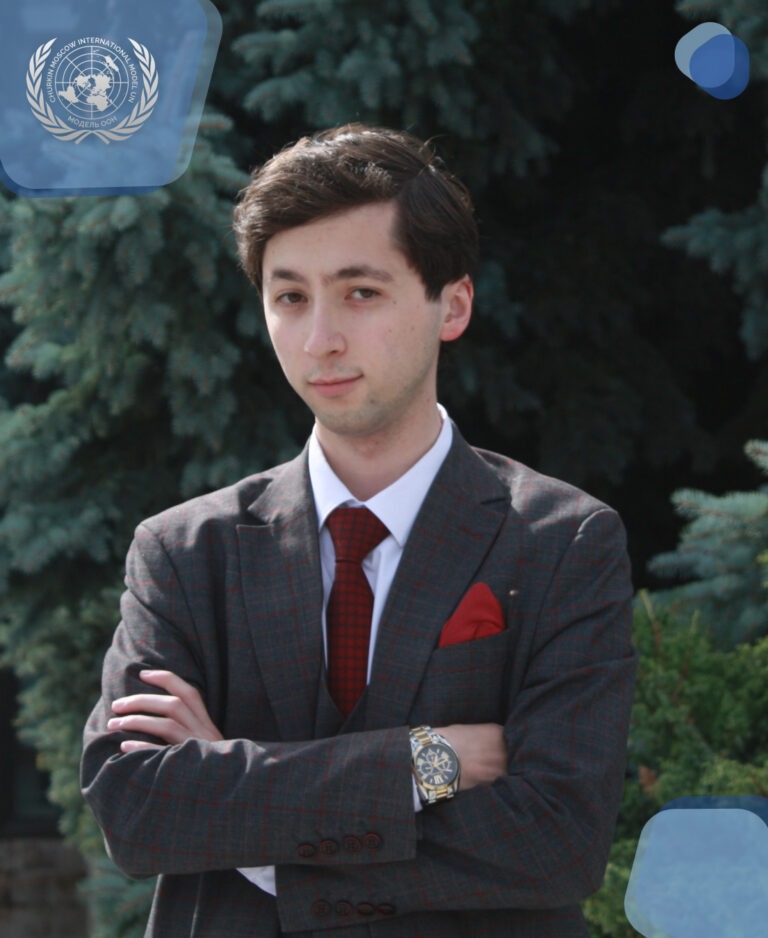
Dear Delegates,
As an Expert of the United Nations Security Council, it is my great honour to welcome you to the C-MIMUN 2027.
The Security Council bears the primary responsibility for the maintenance of international peace and security. In the current geopolitical context, characterized by complex challenges to the global order, the simulation of this principal UN organ acquires particular significance. The agenda of our Committee requires a highly professional approach, objective analysis, and strict adherence to the fundamental principles of international law.
In my capacity as an Expert, I emphasize the necessity of maintaining a constructive and respectful dialogue. Delegates are expected to demonstrate profound knowledge of the issues at hand and a capacity for effective diplomatic compromise. The primary objective of this session is to produce well-founded and viable resolutions through comprehensive negotiation. I eagerly anticipate your active engagement and well-crafted resolutions! Wishing you great success!
Sincerely,
Anastasiia Koleva
Expert of the United Nations Security Council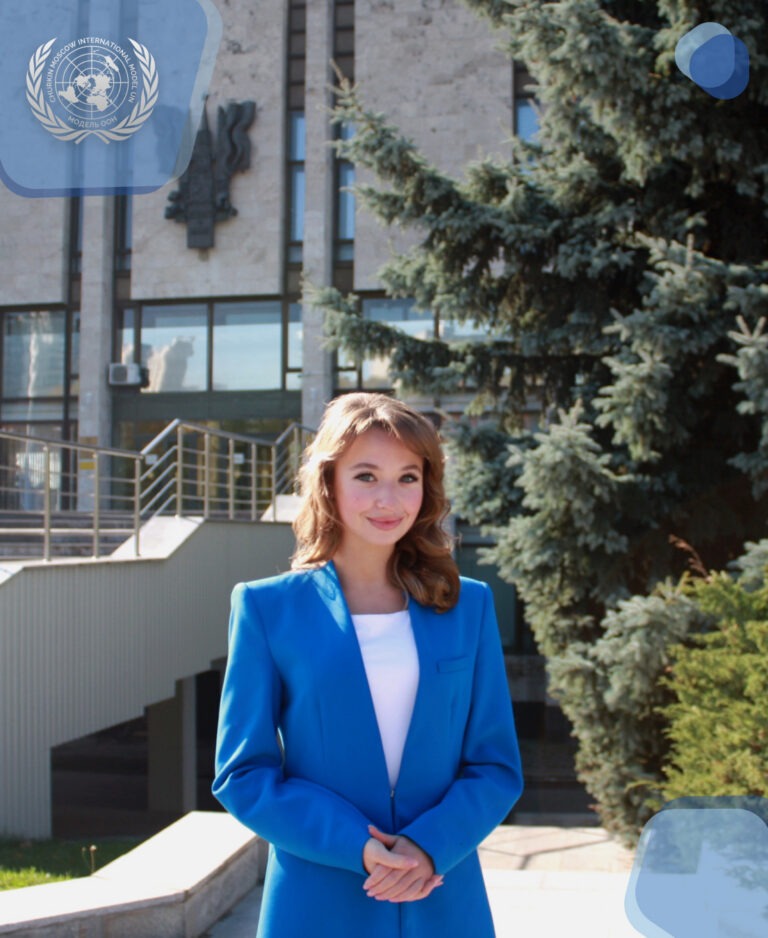
To become a Churkin Moscow International Model UN delegate, one should demonstrate a thorough understanding of the Committee’s agenda. Answering the questions is the first step in the selection process and plays a key role in the formation of the Committee.
From whose perspective should one respond?
At the selection stage, when a country has not yet been assigned, the expert expects not the personal opinion of a student, but the position of a future representative of a country’s delegation. This means that you speak as a potential representative of a state in the Security Council, even if the specific country has not yet been named.
If the question concerns the Security Council’s agenda, you reason from the standpoint of the interests of international peace and security, and not of abstract pacifism. You are not obliged to defend a specific country, but you are obliged to show that you understand: every member of the Security Council has national interests, and the delegate will be obliged to uphold them.
When answering the expert’s question, adhere to a strict structure:
- Positioning: in one or two sentences, clearly state what the question is about and what the framework of interests of the country you represent is.
- Argumentation supported by a source or precedent: in two or three sentences, name a specific document, resolution, article of the Charter or historical example.
- Conclusion or proposal: in one sentence, formulate, from position to argument and to practical conclusion, what this means for the work of the delegate.
Accessible sources for use in substantiating answers to questions:
Priority is given to the Charter of the United Nations, above all Chapters V–VII, to Security Council resolutions with an indication of the number, year and key blocks of official documents, as well as to reports of the Secretary-General on specific missions.
Among the strong sources are notes and statements of the President of the Council and the annual reports of the Council to the General Assembly. Reports of expert groups on sanctions regimes and materials of relevant United Nations agencies are admissible.
Restrictions when answering questions:
1) One should NOT rely on news publications without a reference to a document, blogs, Wikipedia or personal opinions outside the United Nations. When asked about a source, one must name the number of a resolution or a paragraph of the Charter.
2) One should not say “I believe” – the correct formulation is “from the point of view of the delegate”.
3) One should not invent resolution numbers: in the absence of an exact reference, one must honestly state that the number is not named, but that the substance amounts to the corresponding provision.
4) One should not resort to pacifist slogans, since the Council is empowered to apply sanctions and force.
5) One should not ignore procedure: it is necessary to show an understanding of the veto, quorum and the distinction between procedural and substantive matters.
General requirements:
Volume: 180–250 words.
Originality: not less than 85%.
A position statement constitutes a formal expression of a particular state’s view on a particular international issue within a meeting of the United Nations system. It reflects the state’s opinion and interests in the international arena, together with its strategic approach to addressing global challenges.
Recommendations for preparing a position statement
It is recommended that you acquaint yourself with the manner in which the agenda is relevant to the state you represent. To this end, you should consult the websites of agencies and non-profit organisations engaged with the issue in question. Scholarly articles examining the relevance of the agenda within the country or region should likewise be reviewed. Pertinent information may additionally be found in media publications; however, the position of the state must rest upon credible sources.
The position of the state should further be considered as expressed in its speeches at United Nations meetings. Verbatim records of meetings yield valuable insight into the state’s perspective on international issues.
The contribution of the state to the problem should then be examined. To this end, consideration should be given to the country’s status under international agreements, as well as to its accountability for treaty compliance.
It is further advisable to set out several bullet points concerning the relevance of the problem to the state, the country’s key activities in tackling the global problem, and the principal challenges encountered in attaining the goals and solutions.
The theses should be systematised and presented logically in a coherent speech format. It should be ensured that the speech is businesslike in style and free of aggressive or provoking statements.
Requirements
The speech should be designed to take between 2 and 5 minutes.
Originality: at least 80%
Structured and logical presentation.
Use of official sources.Formatting
The position statement is formatted in a document and sent to an expert via the Committee’s mail for verification.
Font – Times New Roman;
Font size – 14;
Alignment – justified.
Interval – 1.5;
Margins – at least 2.5 cm on each side.# Country list: Representative 1 Austria 2 Bahrain 3 China (the People's Republic of) 4 Colombia 5 Democratic Republic of the Congo 6 France 7 Latvia 8 Liberia 9 Kyrgyzstan 10 Portugal 11 Russian Federation 12 Trinidad and Tobago 👑President 13 United Kingdom of Great Britain and Northern Ireland 14 United States of America 15 Zimbabwe Observers: 1 African Union (AU) 2 European Union (EU) 3 League of Arab States (LAS) 4 International Committee of the Red Cross (ICRC)